

What Is a Forex Broker Application Solution and How Does It Work?
Oct 12, 2026 • Blog
Introduction
The forex trading industry is becoming increasingly technology-driven, with brokers relying on digital platforms to manage clients, streamline operations, and deliver better trading experiences. As competition grows, having the right technology infrastructure is essential for forex brokerage businesses that want to operate efficiently and scale their services.
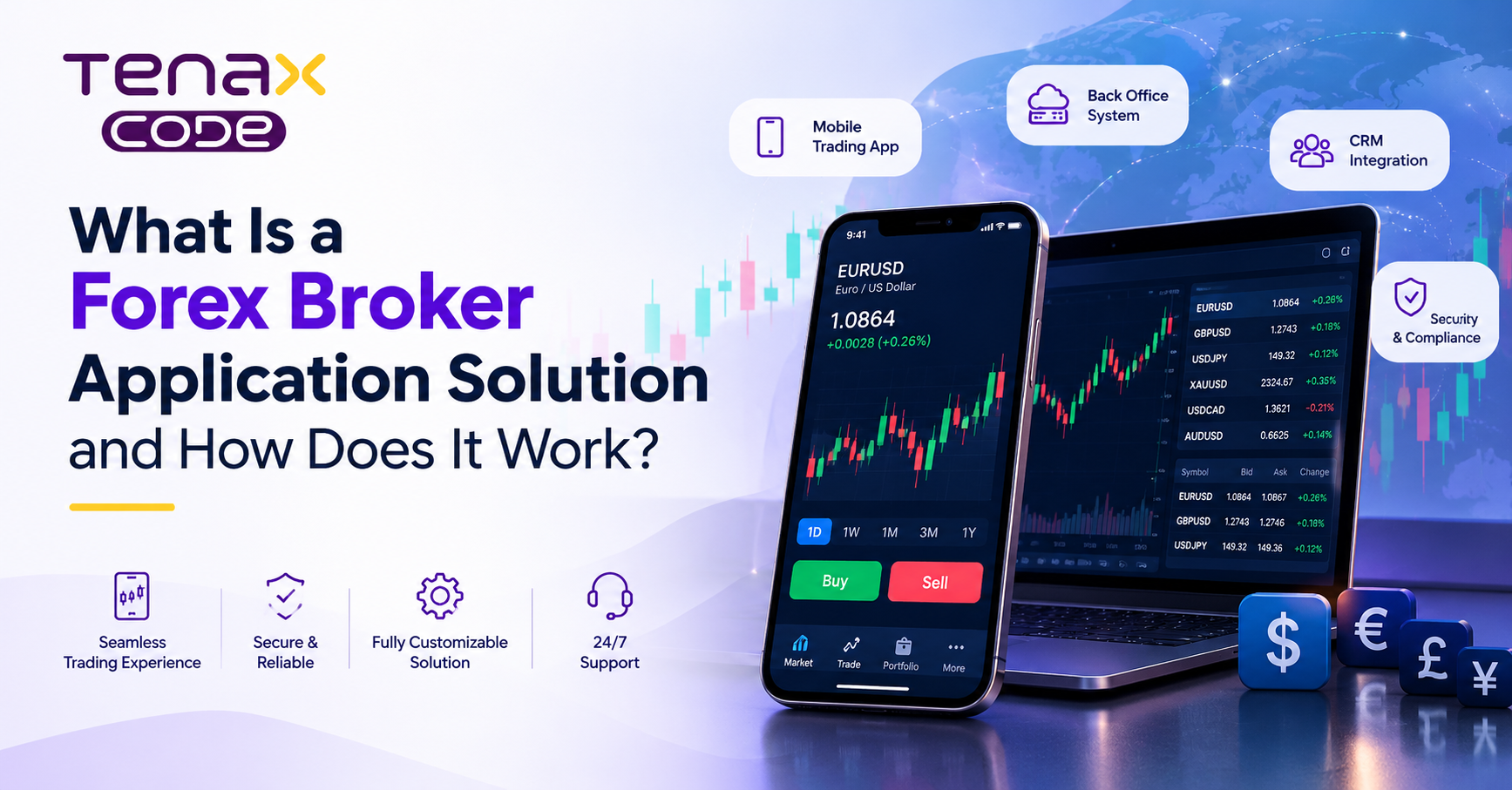
A Forex Broker Application Solution is a technology platform designed to help forex brokers manage essential business operations, including client onboarding, account management, trading platform integration, reporting, and customer communication. Depending on the solution, it may also include CRM functionality, back-office automation, compliance workflows, and performance analytics.
For new brokerage startups and established brokers in India looking to expand into international markets, choosing the right application solution can simplify daily operations and improve business visibility.
In this guide, we will explain what a Forex Broker Application Solution is, how it works, its key features, its benefits, and how to choose the right Forex Broker Application Provider for your business. We will also explore how TenaxCode can fit into the technology evaluation process.
What Is a Forex Broker Application Solution?
A Forex Broker Application Solution is a software system that helps Forex brokerage firms manage their business activities through a centralized digital environment. It connects important operational processes, allowing brokers to organize client information, monitor account activity, manage internal workflows, and access business reports.
Instead of depending on disconnected spreadsheets, manual communication, and multiple standalone tools, brokers can use an integrated solution to improve coordination between sales, support, compliance, and back-office teams.
The exact functionality depends on the provider and the selected package. Some solutions focus primarily on client relationship management, while others combine CRM, back-office administration, trading platform connectivity, reporting, and automation.
A typical solution may help brokers with:
- Client registration and onboarding
- Lead tracking and sales pipeline management
- Trading account administration
- Client communication and support
- Deposit and withdrawal workflow management
- Affiliate and introducing broker management
- Reporting and operational analytics
- Compliance-related documentation and monitoring
The objective is to make brokerage operations more organized, consistent, and easier to manage as the business grows.
How Does a Forex Broker Application Solution Work?
A Forex Broker Application Solution generally works by connecting different brokerage activities within one system. Although implementation varies by provider, the workflow usually follows several stages.
1. Lead Generation and Client Management
The process often begins when a prospective trader submits an inquiry through a website, landing page, referral campaign, or other marketing channel.
The application can capture the lead's information and organize it in a centralized database. Sales teams can then assign leads to representatives, schedule follow-ups, record interactions, and track conversion progress.
This helps brokers reduce the risk of missed inquiries and gives managers better visibility into sales performance.
2. Client Registration and Onboarding
Once a prospect decides to open an account, the onboarding process begins. Depending on the system, the application may support digital registration forms, document collection, identity verification integrations, and approval workflows.
Authorized staff can review submitted information and monitor onboarding progress.
For brokers operating in multiple jurisdictions, onboarding requirements should be configured according to the applicable legal and regulatory framework. Software can support these processes, but purchasing an application does not automatically make a brokerage compliant.
3. Trading Account Integration
After onboarding approval, the broker may need to create or link the client's trading account.
A suitable application can integrate with supported trading platforms and broker infrastructure through APIs or other approved connectivity methods. This allows relevant account information to be exchanged between systems.
Depending on the integration, staff may be able to view account details, account status, and selected trading-related information from the application.
The scope of integration should be confirmed with the provider before implementation. Not every solution supports every trading platform or account-management function.
4. Back-Office Operations
Back-office teams manage operational tasks such as account administration, client requests, transaction-related workflows, and internal reporting.
A Forex Broker Application Solution can centralize these activities and establish structured processes for reviewing, approving, and tracking requests.
For example, a withdrawal request may be recorded in the system, assigned to an authorized team member, reviewed according to internal controls, and updated as it moves through the approval process.
Automation can reduce repetitive administrative work while preserving the need for appropriate authorization and oversight.
5. Reporting and Performance Monitoring
The application can consolidate operational information into dashboards and reports. Depending on available features, managers may monitor lead conversions, client activity, support requests, onboarding progress, and selected financial or operational metrics.
These insights can help brokerage teams identify bottlenecks, improve service delivery, and make more informed business decisions.
The accuracy of the reports depends on data quality, integration coverage, and the way the system is configured.
Key Features of a Forex Broker Application Solution
When evaluating a solution, brokers should focus on features that address their actual operational requirements.
1. Centralized CRM
A built-in CRM helps teams maintain client profiles, record communications, organize leads, and track sales activities. Centralized information improves coordination between marketing, sales, and customer support teams.
2. Automated Workflows
Workflow automation can handle repetitive tasks such as lead assignment, follow-up reminders, onboarding notifications, and internal request routing. This helps teams work more consistently and reduces avoidable manual errors.
3. Trading Platform Integration
Integration with supported trading platforms can reduce duplicate data entry and improve access to relevant account information. Brokers should verify compatibility, synchronization frequency, API access, and integration limitations before choosing a provider.
4. Client Portal
A client portal may allow traders to access account-related information, submit requests, update permitted details, and communicate with the brokerage.
A well-designed portal should offer a straightforward user experience and appropriate access controls.
5. Reporting and Analytics
Reporting tools help managers evaluate business activity, monitor operational performance, and understand trends. Customizable dashboards can make important information easier to review.
6. Security and Access Management
Forex brokerage systems handle sensitive customer and business information. Important security capabilities may include role-based access controls, multifactor authentication, encryption, audit logs, secure integrations, and backup and recovery procedures.
Brokers should verify which controls are available and how they are implemented rather than relying solely on general security claims.
7. Affiliate and Introducing Broker Management
Some applications include features for managing affiliate relationships, referral tracking, commission calculations, and partner performance reporting.
These capabilities can be useful for brokers that acquire clients through affiliate marketing or introducing broker networks.
Benefits of Using a Forex Broker Application Solution
Improved Operational Efficiency
Centralizing brokerage workflows reduces dependence on disconnected tools. Teams can manage tasks, access relevant information, and coordinate activities more efficiently.
Better Client Experience
Organized onboarding, faster request handling, and clearer communication can create a smoother customer journey. A centralized record of client interactions also helps support teams respond with greater context.
More Effective Lead Management
Lead tracking and follow-up automation help sales teams prioritize prospects and maintain consistent communication. Managers can also identify where potential clients are dropping out of the conversion process.
Greater Business Visibility
Consolidated reporting provides a clearer picture of operational performance. This can support planning, resource allocation, and process improvement.
Support for Business Growth
As a brokerage expands, its operational workload and integration requirements often increase. A scalable application can help accommodate additional users, workflows, markets, and supported trading accounts, subject to the system's architecture and capacity.
More Consistent Internal Controls
Defined workflows, permission settings, and audit trails can support better oversight of business processes. However, these tools complement rather than replace professional compliance advice, internal governance, and regulatory obligations.
How to Choose the Right Forex Broker Application Provider
Selecting a Forex Broker Application Provider is an important technology decision. Brokers should evaluate the provider's capabilities, implementation process, security practices, and long-term support before committing.
Consider the following factors:
1. Business requirements: Identify whether you need CRM, back-office management, trading integrations, client portals, affiliate management, or a combination of these capabilities.
2. Integration compatibility: Confirm that the solution supports your existing trading platforms, payment-related systems, communication tools, and other required services.
3. Customization and scalability: Check whether workflows, dashboards, permissions, and reporting can be adapted to your operating model as the business grows.
4. Security and data protection: Ask about access controls, encryption, audit logging, backup policies, incident response, and applicable data protection requirements.
5. Implementation and training: Understand the deployment timeline, migration process, onboarding assistance, documentation, and staff training available.
6. Pricing and ongoing costs: Review setup fees, licensing or subscription charges, customization expenses, integration costs, maintenance, and support fees.
7. Technical support: Evaluate support availability, escalation procedures, service-level commitments, and the provider's process for updates and troubleshooting.
8. Demonstrations and references: Request a product demonstration and, where possible, relevant customer references. Test realistic workflows before making a final decision.
For businesses operating in India, it is also important to assess the applicable regulatory framework. Forex and derivatives activities can be subject to specific restrictions and requirements depending on the instrument, transaction, and jurisdiction. Brokers should obtain qualified legal and compliance advice before launching or expanding services.
Why Consider TenaxCode for Forex Broker Application Solutions?
Choosing the right technology partner involves finding a provider whose capabilities align with your business model, technical environment, and growth plans.
TenaxCode can be considered as part of the evaluation process for businesses exploring Forex brokerage technology and related CRM requirements. Before selecting any solution, prospective customers should confirm the provider's current product scope, supported trading platforms, available integrations, customization options, security controls, and implementation services directly with its team.
A structured evaluation should establish whether the proposed solution can support your onboarding process, lead management, operational workflows, reporting requirements, and future expansion plans.
Rather than choosing software based only on the number of advertised features, compare the available functionality against measurable business requirements. A demonstration based on your actual workflows can help determine whether the solution is suitable for your brokerage.
Common Mistakes to Avoid When Choosing a Forex Broker Application Solution
Even a feature-rich application may not deliver the expected value if it does not match the brokerage's requirements.
Avoid these common mistakes:
- Choosing a provider without checking trading platform compatibility.
- Overlooking data security and access-control requirements.
- Ignoring implementation, integration, and ongoing support costs.
- Selecting a system that cannot accommodate expected business growth.
- Assuming that software alone guarantees regulatory compliance.
- Failing to test workflows before migrating important business data.
A clear requirements checklist and practical product demonstration can help reduce these risks.
Conclusion
A Forex Broker Application Solution helps brokerage firms organize client management, onboarding, back-office workflows, integrations, and reporting within a more connected operational environment. When appropriately selected and implemented, it can reduce repetitive work, improve internal coordination, and support a better client experience.
The right solution depends on the brokerage's size, operating model, technical requirements, security expectations, and plans for expansion. Evaluating integration compatibility, customization, scalability, pricing, and ongoing support is essential before making a decision.
For businesses exploring brokerage technology, TenaxCode can be included in the provider evaluation process. Reviewing its current capabilities against your requirements will help you determine whether it is an appropriate fit for your business.
Frequently Asked Questions (FAQs)
1. What is a Forex Broker Application Solution?
A Forex Broker Application Solution is a software platform that helps forex brokers manage activities such as client onboarding, CRM, account administration, reporting, and operational workflows. Its exact capabilities depend on the provider and selected configuration.
2. How does a Forex Broker Application Solution work?
It connects brokerage processes through a centralized system. The application may capture leads, support client onboarding, integrate with trading platforms, manage operational requests, and generate reports based on available data and integrations.
3. What features should a Forex Broker Application Solution include?
Important features may include centralized CRM, onboarding workflows, trading platform integration, client portals, reporting, access controls, automation, and affiliate management. The best feature set depends on the brokerage's needs.
4. How do I choose a Forex Broker Application Provider?
Evaluate the provider's product capabilities, integration compatibility, security practices, customization options, pricing, implementation process, technical support, and ability to scale. Request a demonstration before making a decision.
5. Is a Forex Broker Application Solution suitable for new brokers?
Yes. A suitable solution can help new brokerages establish organized processes for lead management, onboarding, client communication, and reporting. Startups should compare implementation costs and scalability with their business plans.
6. Can a Forex Broker Application Solution integrate with trading platforms?
Many solutions support integrations with selected trading platforms through APIs or other connectivity methods. Brokers should verify compatibility and confirm which account, trading, and reporting data can be synchronized.
7. How can TenaxCode help businesses evaluating forex brokerage technology?
Businesses can evaluate TenaxCode against their CRM, workflow, integration, reporting, and scalability requirements. Contact the company directly to confirm its current offerings, technical capabilities, and implementation support.
8. Does a Forex Broker Application Solution guarantee regulatory compliance?
No. Software can support documentation, monitoring, access controls, and compliance workflows, but it cannot guarantee compliance. Brokers remain responsible for meeting the legal and regulatory requirements applicable to their activities and jurisdictions.