

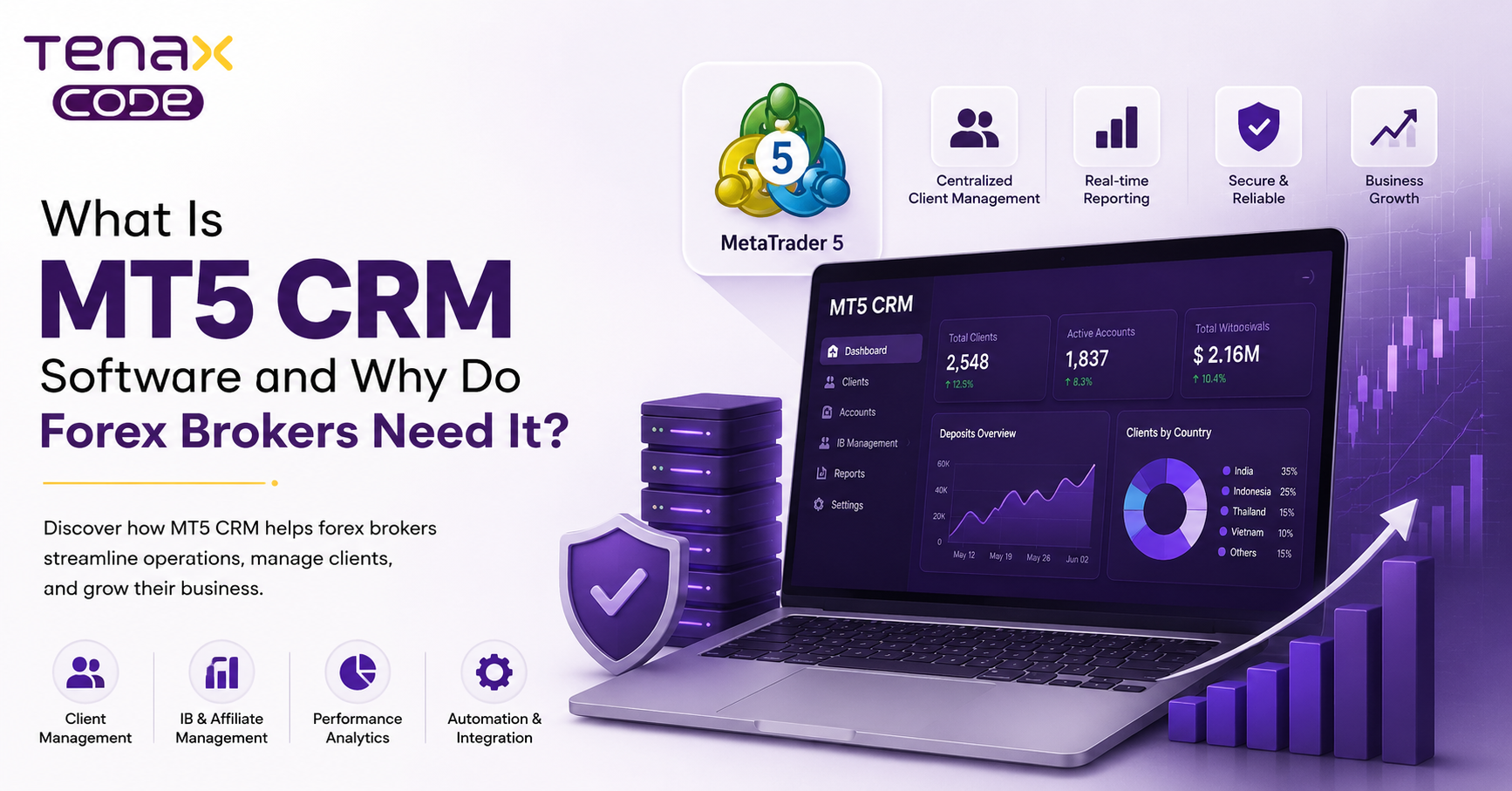
The Forex industry is becoming increasingly technology-driven, and brokers need more than a trading platform to manage their operations efficiently. While MetaTrader 5 (MT5) provides powerful trading capabilities, brokers also require a dedicated system to manage clients, leads, deposits, withdrawals, accounts, and business operations.
This is where MT5 CRM software for brokers adds real value. An MT5 CRM system connects customer relationship management with brokerage operations, helping brokers create a more organized, automated, and efficient client management process.
In this guide, we explain what MT5 CRM software is, how it works, its key features, and why it is important for modern forex brokers.
What Is MT5 CRM Software?
MT5 CRM software is a customer relationship management solution designed to work with the MetaTrader 5 trading environment. It helps forex brokers manage client information, trading accounts, leads, financial transactions, communication, and operational workflows from a centralized platform.
A traditional CRM mainly focuses on customer management. However, an MT5 CRM system is specifically designed for the requirements of forex and financial brokerage businesses.
It can connect CRM operations with MT5-related account and trading information, allowing brokers and their teams to manage customer activities more efficiently.
For example, when a new trader registers with a brokerage, the CRM can help the broker manage the registration process, account creation, KYC workflow, deposits, communication, and ongoing client relationship from one system.
How Does an MT5 CRM System Work?
An MT5 CRM system generally acts as a central management layer between the broker's internal operations, clients, and trading infrastructure.
A typical workflow may look like this:
1. A potential client submits a registration form.
2. The lead is added to the CRM automatically.
3. The sales team follows up with the lead.
4. The client completes the required verification process.
5. A trading account is created and managed through the brokerage infrastructure.
6. Deposit and withdrawal activities are tracked.
7. The client receives ongoing support and communication.
8. Management teams monitor performance through reports and dashboards.
The exact integration architecture depends on the broker's technology stack and the CRM provider.
Why Do Forex Brokers Need MT5 CRM Software?
Running a forex brokerage involves managing thousands of client interactions and operational activities. Handling these processes manually through spreadsheets, emails, and disconnected systems can create inefficiencies.
Here are some important reasons brokers use an MT5 CRM for brokers.
1. Centralized Client Management
A dedicated Forex CRM software solution can keep important customer information in one centralized location.
Brokerage teams can manage information such as:
• Client profiles
• Trading accounts
• Lead sources
• Communication history
• KYC status
• Deposit and withdrawal activity
• Account status
• Assigned sales representatives
Having centralized information makes it easier for teams to access relevant client data and provide faster support.
2. Better Lead Management
Lead generation is an important part of brokerage growth. However, generating leads is only the first step. Brokers also need an organized process for managing and converting those leads.
A CRM for forex brokers can help sales teams track leads through different stages, assign leads to sales representatives, monitor follow-ups, and identify potential conversion opportunities.
This can reduce the chances of leads being forgotten or handled inconsistently.
3. Automated Workflows
Automation can significantly reduce repetitive administrative tasks.
Depending on the platform, MT5 CRM software for brokers may support automated workflows for registration, notifications, lead assignment, client communication, and internal processes.
Automation allows brokerage teams to spend more time on customer service and business development instead of repetitive manual tasks.
4. Deposit and Withdrawal Management
Financial transactions are a critical part of brokerage operations. A centralized CRM can help teams monitor deposit and withdrawal requests and their statuses.
Integration with payment systems can further streamline transaction workflows, although the exact functionality depends on the broker's payment infrastructure and regulatory requirements.
5. KYC and Client Verification
Forex brokers need structured processes for onboarding and verifying clients.
An MT5 CRM for brokers can help organize KYC information and track verification status. This gives operational teams better visibility into which clients are pending, approved, or require additional information.
However, brokers should ensure that their technology and onboarding procedures comply with the applicable laws and regulations in the jurisdictions where they operate.
6. Reporting and Business Insights
Data-driven decision-making is increasingly important for forex brokers.
A good Forex broker CRM can provide reports and dashboards covering areas such as:
• New registrations
• Active clients
• Deposits
• Withdrawals
• Lead conversion
• Sales performance
• Client activity
• Revenue-related metrics
These insights can help management identify operational bottlenecks and make more informed business decisions.
Key Features to Look for in MT5 CRM Software
When evaluating an MT5 CRM system, brokers should consider functionality, integration capabilities, scalability, security, and ease of use.
Important features may include:
MT5 Integration
The CRM should support reliable integration with the broker's MT5 environment and provide the data and workflows required by the brokerage.
Client Portal
A secure client portal can allow traders to manage their profiles, accounts, documents, transactions, and other available services.
Lead & Sales Management
Lead capture, assignment, follow-up tracking, and sales reporting can help brokerage teams manage the customer acquisition process.
Admin Dashboard
An intuitive administrative dashboard gives management teams centralized visibility into brokerage operations.
Payment Integration
Integration with supported payment gateways can help streamline deposit and withdrawal workflows.
KYC Management
The system should provide structured tools for collecting and tracking required client verification information.
Reporting
Customizable reports can help brokers monitor operational and business performance.
Scalability
As a brokerage grows, its CRM should be capable of supporting increasing numbers of clients, accounts, transactions, and internal users.
MT5 CRM vs Traditional CRM
A traditional CRM is primarily designed for general customer relationship management. An MT5 CRM for brokers, on the other hand, is built around the operational requirements of a Forex brokerage.
| Feature | Traditional CRM | MT5 CRM |
|---|---|---|
| Customer Management | Yes | Yes |
| Lead Management | Yes | Yes |
| Forex Account Management | Limited | Designed for brokerage workflows |
| MT5 Integration | Usually limited | Core requirement |
| Trading-Related Data | Limited | Supported through integration |
| Deposit/Withdrawal Workflows | Limited | Brokerage-focused |
| KYC Workflows | Varies | Commonly supported |
| Brokerage Reporting | Limited | Designed for broker operations |
For a Forex broker operating with MT5, a specialized CRM can therefore provide a more relevant operational environment than a generic CRM.
How TenaxCode Can Help Forex Brokers
TenaxCode provides Forex CRM software designed to help brokerage businesses manage clients and operational workflows through a centralized technology solution.
Its solutions can support areas such as client management, lead management, brokerage operations, reporting, and workflow automation.
For businesses looking for an MT5 CRM system or a Forex broker CRM, choosing a platform that can align CRM functionality with their brokerage infrastructure is important.
How to Choose the Right MT5 CRM for Brokers
Before selecting an MT5 CRM software for brokers, consider these factors:
1. MT5 integration capabilities – Verify that the CRM can work with your technical infrastructure.
2. Security – Review access controls, data protection, and security practices.
3. Scalability – Ensure the platform can support future business growth.
4. Automation – Look for workflows that reduce repetitive manual tasks.
5. Reporting – Check whether the available reports meet your operational requirements.
6. Client experience – Evaluate the client portal and onboarding journey.
7. Support and customization – Consider integration support and the ability to adapt workflows to your business model.
8. Regulatory requirements – Ensure your processes and technology are appropriate for the jurisdictions in which you operate.
Conclusion
An MT5 CRM system is more than a conventional customer management platform. It can serve as an important operational layer for Forex brokers by connecting client management, lead handling, onboarding, transactions, reporting, and brokerage workflows.
As competition in the forex industry increases, brokers need technology that can improve operational efficiency while delivering a better client experience. A well-designed MT5 CRM for brokers can help centralize business processes, automate repetitive activities, improve visibility, and support long-term scalability.
For brokers looking for reliable Forex CRM software, evaluating integration capabilities, security, scalability, automation, and brokerage-specific features should be a priority. TenaxCode can help businesses explore CRM solutions designed around the operational needs of modern Forex brokerages.
Frequently Asked Questions
What is MT5 CRM software?
MT5 CRM software is a customer relationship and brokerage management solution designed to work with businesses using the MetaTrader 5 ecosystem. It helps manage clients, leads, onboarding, accounts, transactions, communication, and reporting.
Why do forex brokers need an MT5 CRM?
Forex brokers need an MT5 CRM to centralize client information and streamline processes such as lead management, onboarding, KYC, account management, deposits, withdrawals, communication, and reporting.
What is the difference between CRM for forex brokers and a regular CRM?
A regular CRM focuses mainly on customer and sales management. A CRM for forex brokers is designed around brokerage-specific workflows and can provide integration with trading and operational infrastructure.
Can MT5 CRM software automate brokerage processes?
Yes. Depending on the solution, an MT5 CRM can automate processes such as lead assignment, notifications, onboarding workflows, client communication, and other repetitive administrative activities.
How can I choose the best MT5 CRM for brokers?
Compare MT5 integration, security, scalability, automation, reporting, client portal functionality, payment integration, KYC workflows, customization, and technical support before selecting an MT5 CRM for brokers.